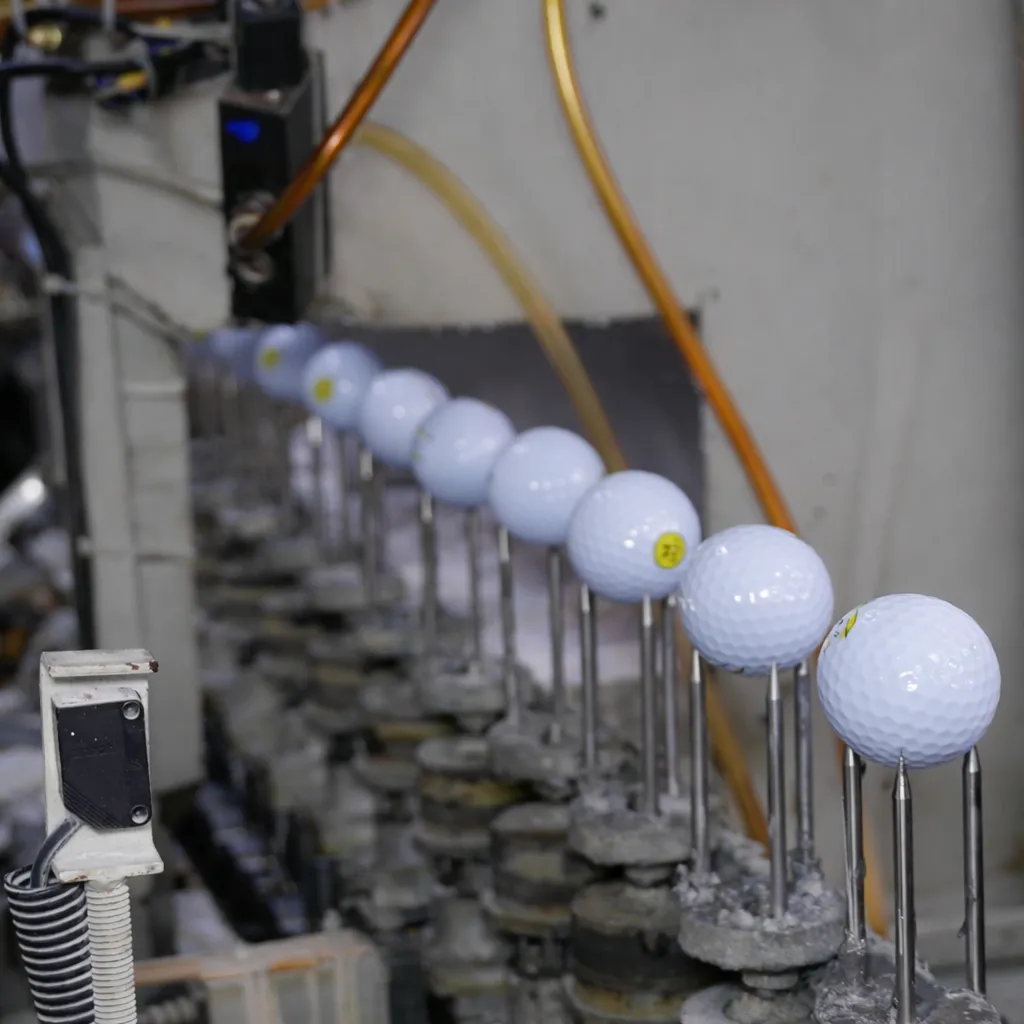
If you run a driving range, you're not buying golf balls. You're buying inventory that gets hit 300 times a day, picked up by a ball collector, washed, and hit again — thousands of times over its life.
A bad batch means premature cracking, unhappy customers hitting scuffed-up balls, and an expensive reorder you weren't planning for. Here's what to look for.
Types of Range Balls
Range balls come in two main constructions:
1-Piece Range Balls A single molded material body. Simple, but counterintuitively, they can cost more than 2-piece range balls — the high-temperature vulcanization cycle is longer, and the painted surface adds material and labor cost.
2-Piece Range Balls A polybutadiene rubber core with a Surlyn cover. This is what most commercial ranges use. Better durability, more realistic flight characteristics, and typically lower cost than 1-piece.
Limited-Flight vs. Full-Flight
Some ranges use limited-flight balls (typically ~70–80% of normal distance) for safety or space constraints. Make sure you specify which you need — limited-flight uses a different core formulation.
What Makes a Good Range Ball?
Four things matter most:
1. Durability The ball needs to survive thousands of strikes without cracking, splitting, or losing its cover. Our 2-piece Surlyn range balls are tested to 1,200 strikes. Look for a supplier who can quote a strike count with a defined test method — "durable" without a number is marketing.
2. Roundness (OOR — Out of Round) A ball that's not perfectly spherical won't fly straight. OOR should be ≤0.004 for range balls. Higher than that and you'll get customer complaints about inconsistent flight.
3. Weight Consistency Range balls should weigh 45–46g with minimal variation batch to batch. Inconsistent weight = inconsistent feel and flight.
4. Visibility Yellow range balls are increasingly preferred over white — they're easier to see against gray sky, stay cleaner-looking longer, and get lost less often in rough. We recommend yellow for outdoor ranges.
White vs. Yellow Range Balls
| White | Yellow | |
|---|---|---|
| Visibility | Lower in overcast/evening | Higher contrast against sky and grass |
| Clean appearance | Shows dirt faster | Stays looking cleaner longer |
| Cost | Same | Same |
| Current trend | Declining | Growing — most new ranges order yellow |
Our recommendation: If you're ordering for a commercial range, go yellow. Your customers will find balls faster, lose fewer, and complain less.
Pricing — What Affects Range Ball Cost
Range balls are a volume business. Cost per ball drops significantly with quantity:
| Order Quantity | Relative Cost/Ball |
|---|---|
| 3,000 pcs | Baseline |
| 10,000 pcs | ~5–10% lower |
| 36,000 pcs | ~10–15% lower |
Other cost factors:
- Logo printing: Adds ~$0.02/ball per color per side. A one-color logo on one side is cheapest.
- Packaging: Bulk loose pack in master cartons is standard for ranges. Retail packaging adds cost.
- Color: Yellow costs the same as white. Custom colors = higher cost.
- Shipping: 36,000 balls ≈ 120 cartons ≈ 1,680 kg ≈ 3.1 cbm. Know your shipping cost before ordering.
How to Evaluate a Range Ball Supplier
Five questions to ask any supplier before placing a bulk order:
- "What's your durability test method and strike count?" — If they can't answer, walk away.
- "Can you send a sample batch for us to test on our range?" — Test 50–100 balls for a week. Crack rate, wear pattern, and customer feedback will tell you more than any spec sheet.
- "What's your batch consistency process?" — You want every carton in your order to contain the same ball. Ask about QC sampling and retention samples.
- "Do you offer floaters for water ranges?" — If your range has water hazards, floater range balls (specific gravity <1.0) prevent constant losses.
- "What's your lead time for reorders?" — You don't want to discover your supplier needs 8 weeks when you're down to your last 30 cartons.
Common Mistake — Buying the Cheapest Range Ball
The cheapest range ball is rarely the best deal. Here's why:
A ball that lasts 800 strikes costs less upfront than one that lasts 1,200 — but you'll replace it 50% more often. Factor in the labor to unpack, check, and put new balls into circulation, and the "cheaper" ball often costs more over its useful life.
Total cost of ownership > price per ball.
Ordering Your First Batch
- Request samples from 2–3 suppliers
- Run them on your range for 1–2 weeks
- Track: crack rate, wear pattern, customer complaints, loss rate
- Compare landed cost (product + shipping + duties)
- Place a trial order before committing to annual volumes
Ready to test a batch on your range?