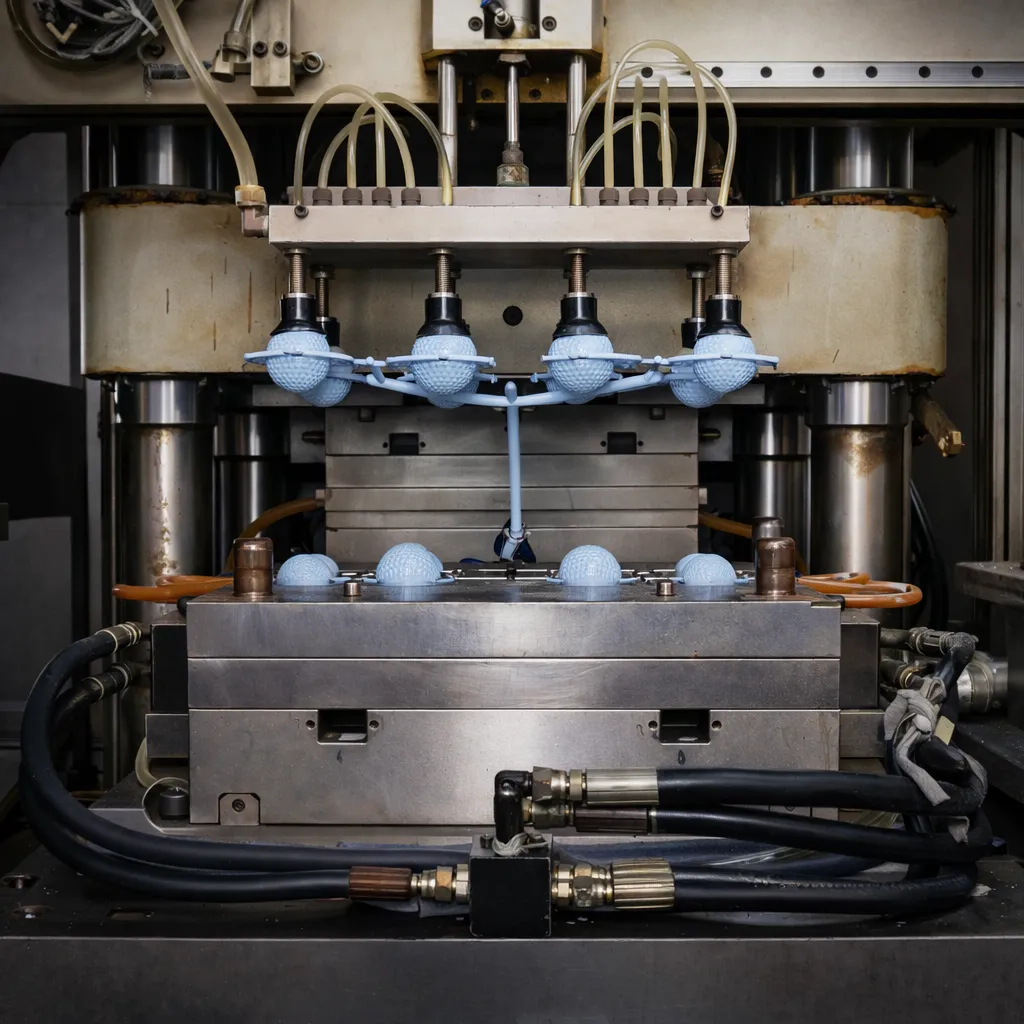
Walk into any golf store and you'll see "2-piece," "3-piece," and "4-piece" on every box. But what do those numbers actually mean? And more importantly for a brand owner — which construction should you choose for your market?
Here's the factory-floor explanation.
The Basic Anatomy of a Golf Ball
Every golf ball has at least two components:
- Core: The center. Usually made of polybutadiene rubber. It's the engine — determines initial ball speed and compression feel.
- Cover: The outer layer. Surlyn or Cast Urethane. Affects durability, spin, and feel.
Add layers between core and cover, and you get multi-piece construction. Those intermediate layers are called mantles.
2-Piece Golf Balls — The Workhorse
Structure: Core → Cover
How it works: A large, high-energy core wrapped in a durable Surlyn cover. Simple. Reliable. Cost-effective.
What you get:
- Maximum distance off the tee (low spin reduces side movement)
- Excellent durability — Surlyn covers resist cuts and scuffs
- Lower manufacturing cost
- Consistent performance across a wide range of swing speeds
Best for:
- Driving ranges (high durability = longer life)
- Entry-level retail brands
- Promotional and corporate gift balls
- Budget-conscious consumers
- Any application where durability and cost matter more than greenside spin
Our take: Don't underestimate 2-piece balls. They're 70%+ of the global market by volume. For many brands, a well-made 2-piece Surlyn ball is the right commercial decision — not a step down. Our 2-piece Surlyn tour ball delivers a COR of 0.784 with 95–115 compression.
3-Piece Golf Balls — The Balancer
Structure: Core → Mantle → Cover
How it works: A mantle layer sits between the core and cover. This layer controls energy transfer — it can reduce driver spin for distance while allowing the cover to generate wedge spin for control.
What you get:
- Distance + short-game spin in one ball
- Softer feel than 2-piece (mantle absorbs vibration)
- Better spin separation: low spin on long shots, more spin on short shots
- Available in Surlyn or Cast Urethane cover
Best for:
- Mid-range and premium retail brands
- Golfers who want one ball that does everything
- Brands positioning between value and premium
- Custom orders where feel matters
Our take: The 3-piece construction is the sweet spot for most private-label brands. It offers genuine performance differentiation from 2-piece without the cost of 4-piece. Our 3-piece Cast Urethane ball (80–85 compression, COR 0.760) is our most popular OEM product.
4-Piece Golf Balls — The Flagship
Structure: Core → Inner Mantle → Outer Mantle → Cover
How it works: Two mantle layers provide fine-grained control over energy transfer. The inner mantle manages speed and spin reduction on long shots. The outer mantle creates spin on approach shots. Combined with a cast urethane cover, this is the most tunable construction.
What you get:
- Maximum performance tuning capability
- Tour-level greenside control
- Softest feel
- Highest perceived brand value
Best for:
- Flagship/premium brand products
- Brands competing with Pro V1 / TP5 positioning
- Markets where "4-piece" = premium in customer perception
Our take: 4-piece cast urethane is our top-tier offering. Compression runs 70–80 for a soft tour feel. But don't choose 4-piece just because it sounds impressive — only go 4-piece if your market will pay the premium. The margin is in selling the right ball to the right market, not in selling the most expensive ball.
How Construction Affects Cost
From a buyer's perspective, each additional layer means:
| Construction | Relative Cost | Key Cost Driver |
|---|---|---|
| 2-Piece | $ | Single injection molding cycle. Faster production. |
| 3-Piece | $$ | Additional mantle injection. Extra QC check. |
| 4-Piece | $$$ | Two mantle layers. Longest production time. Most QC. |
Cover material adds another layer of cost — Cast Urethane is significantly more expensive than Surlyn regardless of construction.
So Which Construction Should You Choose?
Ask yourself:
- Who is your customer? Beginners and range owners want durability. Better players want feel and spin.
- What's your price point? If you're selling at $25/dozen retail, 3-piece urethane makes sense. At $15/dozen, 2-piece Surlyn is the play.
- What are competitors selling? Go one step above or match at a better price.
- What's your brand story? "We make the most durable ball" needs 2-piece Surlyn. "Tour performance at half the price" needs 3-piece urethane.
Still not sure? Tell us your market and price target. We'll recommend the construction that fits.