Standard white golf balls are a commodity. Everyone makes them. Price competition is brutal.
Specialty balls are different. Fewer suppliers. Less price comparison. And customers who need exactly this product — a floater for their water range, an LED ball for their night event — aren't shopping on price.
Here are three specialty categories worth knowing.
Floater Golf Balls — The Water Range Essential
If a driving range has water hazards, standard balls become expensive sinkers. A floater ball has specific gravity < 1.0 — it floats.
Technical specs:
- 2-piece construction, Surlyn cover
- Weight: approximately 39g (lighter than standard 45–46g)
- Buoyancy: floats indefinitely in fresh and salt water
- Durability: 1,000 strikes tested
- Dimple: 332 or 392 available
Who buys them:
- Water range operators who lose hundreds of balls per day to ponds
- Resort courses with water driving ranges
- Coastal and lakeside facilities
- Anyone running a floating range (balls hit onto water, collected by boat)
The business case for range owners: A standard range ball sinks. A floater gets collected and reused. If your range loses 50 balls a day to water — that's 18,250 balls a year. Switching to floaters pays for itself within months.
Customization: Logo printing available. Most range owners print their facility name and "PROPERTY OF [RANGE NAME]" to discourage take-home.
LED Golf Balls — Night Golf That Actually Works
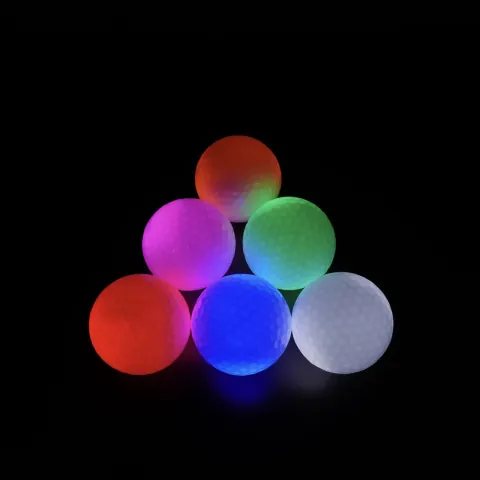
LED golf balls contain a small LED module inside a transparent or translucent core. On impact, the LED activates and flashes — making the ball visible in darkness for 5–8 minutes.
Technical specs:
- 3-piece construction with LED core module
- Surlyn cover
- 7-color LED options — single color or cycling
- Activation: impact-triggered, lasts ~5–8 minutes
- Weight: 44–46g (near-standard feel)
- Battery: non-replaceable, good for ~40 hours of active light
Who buys them:
- Night golf event organizers
- Resort and entertainment venues
- Corporate team-building companies
- Glow golf and party golf operators
What buyers should know:
LED balls are a different category from standard balls — they're an experience product, not a performance product.
- Flight is slightly shorter than a standard ball (COR ~0.645 vs 0.760+)
- They don't feel identical to a standard ball — the LED module changes weight distribution
- Cold weather reduces battery life
- They sell on fun, novelty, and visibility — not on score
Pricing note: LED balls cost significantly more than standard balls to manufacture. The per-unit cost is higher, but the event market supports the pricing — night golf operators charge premium rates and need reliable supply.
Glow-in-the-Dark Golf Balls — Evening Play, No Batteries
Unlike LED balls which use electronics, glow balls use phosphorescent material embedded in the cover — typically SrAl₂O₄ (strontium aluminate) phosphor.
Technical specs:
- 2-piece construction
- Surlyn cover infused with glow phosphor
- Charges under any light source (sunlight, UV, flashlight)
- Glow duration: 4–8 hours after full charge
- No battery, no electronics, no expiration
- COR: ~0.723
Who buys them:
- Twilight and evening golf events
- Driving ranges with evening hours
- Novelty and gift retailers
- Golf entertainment venues
Advantages over LED:
- More natural feel (closer to standard ball weight and balance)
- No battery to die mid-event
- Lower cost than LED
- Can be recharged and reused indefinitely
Limitations:
- Need to be "charged" under bright light before use
- Glow fades gradually — brightest in the first hour
- Less dramatic visual effect than LED (steady glow vs. flashing)
Gold-Plated and Gift Balls — The Premium Niche
For corporate awards, retirement gifts, tournament trophies, and display purposes:
- Electroplated golf ball with metallic finish
- Gold, silver, rose gold, or custom plating
- Logo engraving or printing available
- Display case packaging
- Not for play — purely commemorative
These balls sit on desks and shelves. Every time someone sees it, they see your brand. For the right corporate client, a gold-plated ball with their logo is more impactful than any brochure.
Is a Specialty Ball Right for Your Market?
Specialty balls work when:
- You're selling to ranges, resorts, or event companies — not retail consumers
- Your customer has a specific problem (water loss, night visibility, event differentiation)
- You're willing to educate your customers — specialty products require explanation
They don't work when:
- You're trying to compete on price with standard balls
- Your customer base is purely retail consumers
- You can't explain the product's use case clearly
Interested in a Specialty Ball?
Tell us your use case. We'll tell you which ball fits — and send samples to prove it.